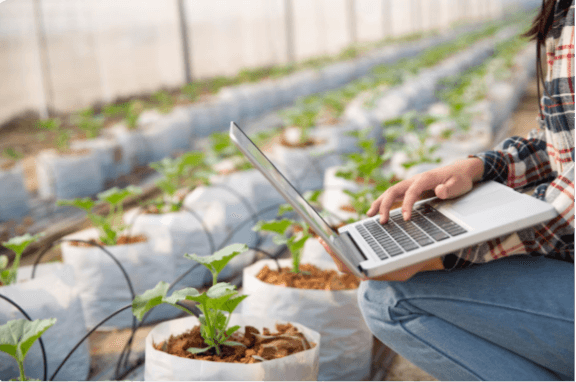
Digitalisation of Seeds Supply Chain
Where AgTech meets ESG frameworks. A practitioner's guide to building reporting-ready, investor-grade ESG architecture across the agricultural value chain — starting with the seed.
Get In TouchKey Insight
Agriculture accounts for approximately 25–30% of global greenhouse gas emissions when the full food system is considered — and consumes 70%of the world's freshwater. If we are serious about meeting the UN Sustainable Development Goals, the transformation must begin at the very start of the food value chain — the seed.
This whitepaper explores how digitalising the seeds supply chain is becoming a powerful lever for Environmental, Social, and Governance impact — mapping the digital ecosystem against the frameworks that matter most: TCFD, GRI, EU Taxonomy, and the incoming CSRD/ESRS requirements. The companies that embrace this convergence will not just grow better seeds; they will build transparent, sustainable, and accountable value chains that capital markets increasingly reward.
25–30%
Of global GHG from food systems
70%
Of freshwater used by agriculture
100%
End-to-end traceability
Deep Dive
The Imperative: Agriculture and ESG
The global food system is at a crossroads. Population growth, climate volatility, water scarcity, and biodiversity loss are converging to create unprecedented pressure on agricultural supply chains. At the same time, investors, regulators, and consumers are demanding greater transparency and accountability from the companies that feed the world. The seeds supply chain sits at the intersection of food security, climate action, and social equity — yet it has historically operated with limited digital infrastructure and minimal ESG integration.
Environmental Impact: Precision Over Waste
Sensor-based farm data and GPS-driven weather insights allow seed growers to reduce water usage, minimise chemical inputs, and optimise planting decisions before a single seed enters the soil. A centralised Data Hub powers recommendations on soil pH, irrigation needs, and fertiliser application — replacing guesswork with precision. The outcomes are significant: lower nitrous oxide emissions from reduced fertiliser overuse, healthier soils through optimised tillage and mulching, and reduced agrochemical runoff into waterways.
Social Impact: Empowering Farming Communities
Connected platforms and Farm Planner Applications bring expert knowledge directly to smallholder farmers and vegetable producers through Demo Farms and remote monitoring. This means improved labour utilisation, safer biosecurity practices, and access to crop guides and disease resistance guidelines historically reserved for large-scale operations. By enabling multiple farm management from a single platform, digitalisation creates the infrastructure for cooperative models, shared learning, and community-level resilience against climate shocks.
Governance: Traceability and Accountability
Every stage of the digital seeds supply chain — from contract farming and seed multiplication through moisture testing, grading, treatment, and packaging — is now trackable. Seed Testing Labs verify germination rates and purity, feeding quality data back into the system. This end-to-end traceability gives stakeholders, investors, and regulators a transparent view of how seeds move from field to distribution network.
Part I — The Digital Seeds Supply Chain Ecosystem
Six interlocking nodes generating data into a centralised intelligence layer
Grower & Producer Connection
Real-time farm data through IoT sensors and GPS-based weather systems, feeding contract farming arrangements with plant breeders.
Seed Processing Plant
Moisture testing, drying, pre-cleansing, fine cleaning, gravity grading, treatment, and packaging — connected platforms monitoring every step.
Seed Testing Labs
Dedicated laboratories verify germination rates and purity, creating the evidentiary trail for regulatory compliance.
Data Hub & Farm Planner
Centralised intelligence delivering recommendations on spacing, depth, soil pH, irrigation, biosecurity, mulching, and inputs.
R&D & Innovation
New seed development, climate modelling, and sustainable agriculture practices — all informed by continuous data flow.
Distribution & Knowledge Transfer
Optimised distribution networks, Farm Planner Applications, and Demo Farms bringing best practices to producers in the field.
Seed-to-Distribution Flow
Field
Processing
Testing
Data Hub
Distribution
Linear & Resource-Heavy vs Circular & Intelligent
🔄 Old Linear Model
- Manual scouting and scheduled spraying
- Fertiliser overuse and nitrous oxide emissions
- Guesswork on irrigation and soil pH
- Limited supplier visibility
- Knowledge concentrated at scale operations
🌱 Digital Circular Model
- Sensor-driven decisions and precision dosing
- Reduced inputs, lower emissions, cleaner runoff
- Tailored irrigation and soil-pH guidance
- Connected platforms with grower-level traceability
- Equitable knowledge access via Farm Planner Apps
Part II — ESG Framework Alignment
How the digitalised seeds supply chain maps to the reporting frameworks that matter most
TCFD
Climate modelling and GPS-based weather intelligence support climate-related risk assessment and scenario analysis under TCFD's Strategy, Risk Management, and Metrics & Targets pillars.
GRI Standards
Tailored irrigation supports GRI 303-3/303-5; precision fertiliser supports GRI 305-1 and 305-3; supplier monitoring supports GRI 308 and 414; Demo Farms support GRI 413 and 404.
EU Taxonomy
Activities enabling climate change adaptation in agriculture align with the Substantial Contribution criteria; equitable access supports the DNSH minimum social safeguards under UNGP.
CSRD / ESRS
End-to-end supply chain data positions companies for compliance with ESRS E1 (Climate), E3 (Water), S2 (Workers in the Value Chain), and G1 (Governance).
ESG Scorecard at a Glance
Environmental
Precision agriculture, climate-resilient R&D, lower emissions and freshwater intensity
Social
Knowledge transfer, smallholder empowerment, equitable access via Demo Farms
Governance
End-to-end traceability, supplier assessment, full audit trail seed-to-distribution
Outcomes Across the Three Pillars
🌿 Environmental
- • Customised crop management
- • Tailored irrigation strategies
- • Rapid response to climatic changes
- • Reduced emissions through precision agriculture
- • Climate-resilient seed R&D
- • Frameworks: TCFD · GRI 303/305 · EU Taxonomy (Climate Adaptation)
👥 Social
- • Multiple farm management
- • Improved labour utilisation
- • Knowledge transfer to smallholders
- • Equitable access to agricultural intelligence
- • Community empowerment through Demo Farms
- • Frameworks: GRI 413/404 · SDG 2/8/10 · EU DNSH Social Safeguards
📊 Governance
- • End-to-end supply chain traceability
- • Supplier environmental & social assessment
- • Data-driven transparency
- • Connected platform accountability
- • Full audit trail from seed to distribution
- • Frameworks: GRI 308/414 · CSRD/ESRS · TCFD Metrics & Targets
Ramesh Swaminathan & Karthikram Sankaranarayanan
Knowledge series · Digitalisation of Seeds Supply Chain
ESG Intelligence.
AI-Powered.
At Sustantix, we empower organizations to drive sustainable growth through a fusion of industry expertise, process excellence, digital technologies, and AI.
As a highly agile consulting and solutions partner, we specialize in delivering actionable sustainability insights that align with regulatory mandates and enhanced long-term business performance.
https://www.sustantix.com……….watch out for our next Knowledge Series……….